How can Advanced Compressed Air Energy Storage support renewables | Interview with Sara Taylor from Hydrostor
October 7, 2025
Long duration energy storage (LDES) will become increasingly important as Australia’s coal-fired power stations retire and the share of wind and solar grows. Many solutions are being explored to fill the LDES gap, including pumped hydro, gravity storage, various types of chemical storage, and compressed air.
In this article, we focus on how compressed air energy storage technology has advanced in recent years and how it could be deployed in Australia’s National Electricity Market (NEM).
Hydrostor is a leading developer and operator of advanced compressed air energy storage (A-CAES). Energy Synapse sat down with Sara Taylor from Hydrostor to learn more about the opportunities for this technology in Australia. Sara Taylor is Hydrostor’s Senior Director of Government and Regulatory Affairs in Australia. She has over 15 years of regulatory and compliance experience across the Australian energy sector, including roles with regulators, retailers, and network businesses. Sara holds a Master of Science in Global Affairs from New York University, where she concentrated on Energy and Environment Policy.
The core technology behind compressed air energy storage (CAES) has been around for decades, with commercial deployments going back to the 1970s. How has Hydrostor advanced this technology?
Compressed air energy storage technology has existed for decades, but hasn’t been commonly deployed because of a few key drawbacks. First, when existing CAES facilities charge by pumping compressed air into underground caverns, the heat that is created during the compression process is vented to the surrounding atmosphere rather than being captured and stored. Natural gas combustion is then used to reheat the compressed air as it is released and expanded during the discharge process.
Hydrostor’s innovation, a proprietary thermal storage system, eliminates the need for a fuel source by capturing heat from the charging process for later use during discharge. In addition to eliminating the need for natural gas, Hydrostor’s thermal storage innovation improves system efficiency, and reduces overall operating costs.
The other main difference between traditional CAES and Hydrostor’s A-CAES is the type of underground cavern used to store compressed air. For traditional CAES, that requires finding salt formations, building salt caverns there, and siting storage facilities in those locations. However, salt formations are relatively rare and aren’t commonly located where the grid demands large-scale energy storage.
Since A-CAES facilities use hydrostatic pressure to reduce the required cavern volume, Hydrostor’s A-CAES caverns can be created in most stable, hard-rock geological settings, greatly increasing the number of locations around the world where projects can be delivered.
Hydrostor has a few utility-scale projects under development in Australia. Can you tell us more about these projects?
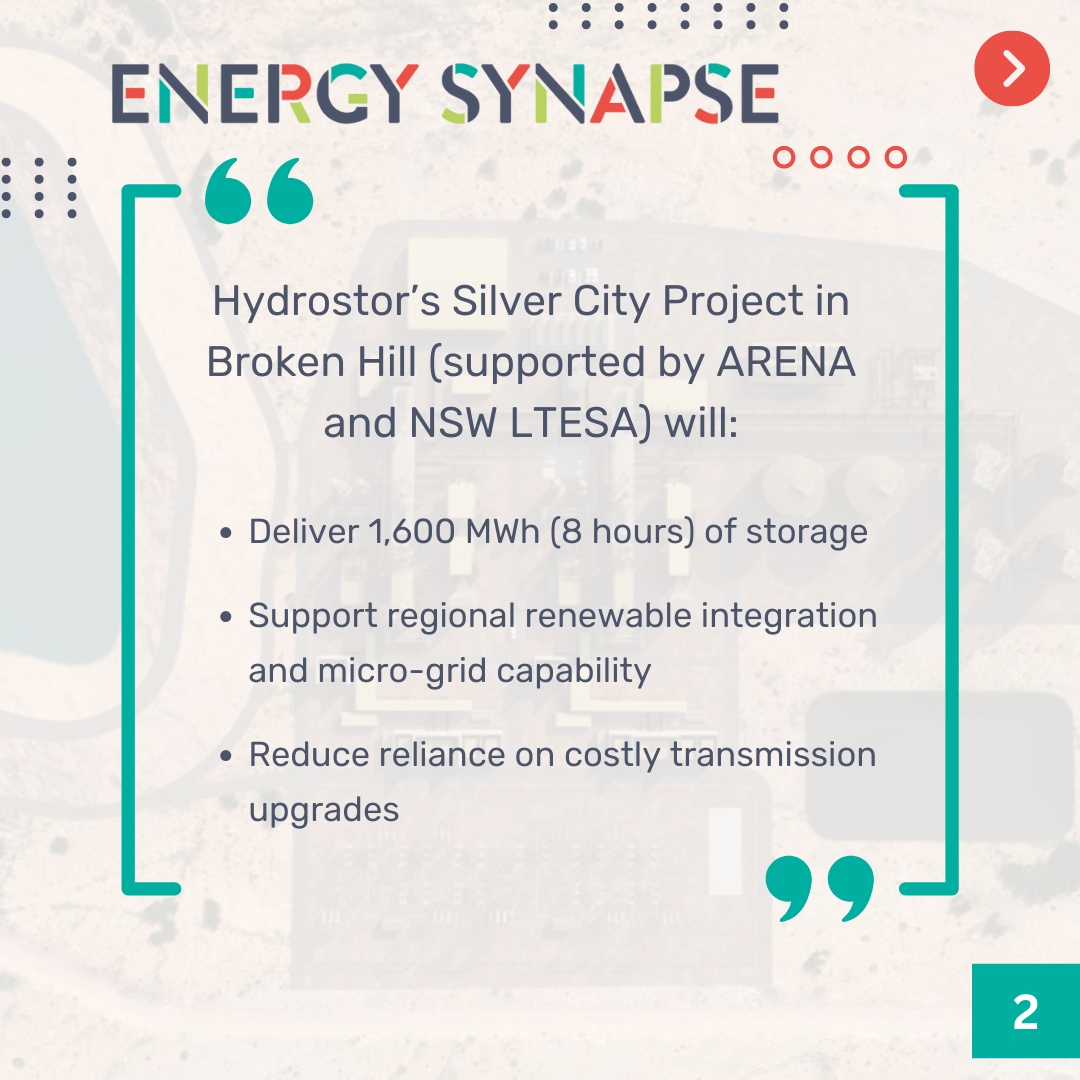
Hydrostor’s first major project in Australia, the Silver City Energy Storage Centre, is located in Broken Hill. We are also looking at the suitability of other areas in NSW, South Australia, and Victoria for A-CAES projects.
The Silver City Energy Storage Centre can discharge 1,600 megawatt hours (MWh) of electricity, capable of delivering 8+ hours of energy on a full charge. The project will eliminate the need for major investments in expensive new transmission lines, estimated to cost billions.
Silver City is also able to serve as a backbone to the region’s mini-grid, linking all of the diverse renewable resources in the area so the region can run on its own power if needed after a blackout. The project provides unmatched benefits to consumers in a remote region with extensive renewable infrastructure and resources.
What type of project/application is best suited for Hydrostor’s Advanced Compressed Air Energy Storage (A-CAES) technology?
Hydrostor’s A-CAES technology can provide power for 8+ hours, and is best used to meet “intra-day” needs. In other words, to provide back-up power for periods each day when there may be gaps in capacity and demand. The more renewables that are added to the grid, the longer periods of time the grid needs storage to fill these gaps.
Batteries are a great storage solution for short durations, but they often aren’t economical for periods of time that last longer than four hours. For example, the levelised cost of storage (LCOS) for lithium-ion at 8-hours is US$250/MWh, and Hydrostor’s LCOS at 8 hours is US$176/MWh.
Pumped hydro is another great mechanical storage solution for longer duration storage needs, but it is difficult to site and requires large amounts of land and water. A-CAES can provide power for these longer durations, and uses significantly less land and water than pumped hydro facilities. For example, a pumped hydro system with a standard operating head of 150 meters would require 20 times more water than A-CAES, while a very high-head pumped hydro system with a 600 meter head would still require five times more water.
Are there any barriers that need to be addressed to accelerate the deployment of A-CAES?
Technologies such as A-CAES face a number of barriers as the structure of the market and regulatory framework has not transitioned along with the energy mix. Hydrostor advocates for market settings and regulatory reform that will remove barriers and incentivise further investment in A-CAES and other forms of long duration storage in Australia.
Fundamentally, the key market barrier is there is insufficient value recognition for long duration storage, and the ancillary services they provide. The energy-only market, and current setting make long-term contracting difficult if not impossible for new developers. This lack of long-term revenue certainty makes it difficult to bring the cost of capital to a reasonable level to allow for commercial development at scale. LDES, including A-CAES, are capital heavy projects, therefore future revenue potential and payback risk is factored into the cost of capital, in an already capital constrained world.
Programs that incentivise and derisk projects such as Silver City are increasingly important, as market signals for zero emissions firming services are being developed through market reform. Examples include ARENA funding, state-based recoverable grant programs and the Capacity Investment Scheme (CIS). They all play an important role. Silver City has been able to move forward relatively quickly compared to development opportunities in other countries due to a mix of ARENA funding, the NSW Emerging Energy Program, and most importantly, the LTESA program.
Hydrostor also supported Transgrid’s rule change proposal submitted to the AEMC to improve cost-recovery for non-network options for reliability. This was an important step toward removing some of the barriers to compensating LDES for providing essential system services, such as reliability and inertia, to the grid. Under the current regulatory framework, these services are procured through Regulatory Investment Test for Transmission (RIT-T). RIT-Ts can take a considerable amount of time to complete leading to significant delays from a RIT-T being released and a network service agreement being signed, increasing exposure to cost increases and skills shortages. Reform is also required to ensure non-network options are genuinely considered, and the process is refined in the long-term interest of consumers.
Are there any unique considerations that project proponents need to take into account if they are thinking about using A-CAES?
Project proponents considering A-CAES should recognise that while the development pathway shares similarities with pumped hydro, particularly in terms of long lead times, it is generally simpler to deliver A-CAES within the Australian market. The most influential factor in siting decisions will be identifying suitable geology that aligns with strong grid nodes or areas of network congestion, where the value of essential system services such as reliability, inertia, and system strength is recognised.
A-CAES’s smaller surface footprint offers advantages in terms of environmental impact and land use flexibility, but developers must still navigate state-based planning approvals, environmental assessments, and meaningful community engagement.
Additionally, A-CAES systems only use air, rock, and water, not the hazardous materials or critical minerals common in many other energy storage installations. This means that A-CAES facilities have a much smaller risk profile than other types of energy storage like lithium-ion batteries.
As an emerging technology, A-CAES requires additional effort to educate stakeholders on what it is, what it isn’t and how it works. Being new adds complexity, making transparent, proactive engagement critical to project success.
About Energy Synapse
Energy Synapse is an Australian modelling and analytics firm specialising in wholesale electricity markets, renewable energy, and energy storage. We can tailor our market and revenue models to account for the unique technical parameters of any storage technology, including A-CAES. Learn more about our modelling services.