Minimum System Load: Overcoming a new challenge as rooftop solar grows
May 19, 2026
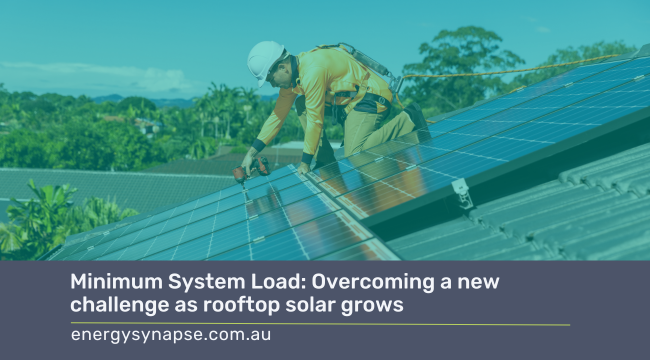
Australia leads the world in rooftop solar uptake. More than one-third of homes around the country have installed rooftop solar, with Queensland and South Australia leading the way at over 50%.
As rooftop solar continues to grow, a Minimum System Load (MSL) challenge has emerged. The Australian Energy Market Operator (AEMO) has responded by using Type 1 & 2 Transitional Services to procure solutions.
Why is Minimum System Load an operational challenge?
Australia’s grid was built around large synchronous generators (coal, gas, hydro) whose spinning turbines provide more than just electricity. They deliver inertia, fault current, voltage stability, and frequency management. This is the invisible scaffolding that keeps the grid stable when something goes wrong. To deliver these services, these large-scale generators need to operate above their minimum safe operating levels (MSOL).
As distributed PV installations have continued to grow, minimum operational demand (the lowest level of demand met by generation from the grid) has been declining in the middle of the day across all regions of the National Electricity Market (NEM). In these periods, it may not be possible to dispatch enough large-scale generators above their minimum safe operating levels to deliver essential security services.
The Victorian and South Australian regions, in particular, have been operating at times with very high levels of distributed PV and low load, called Minimum System Load (MSL) conditions, which may require operational actions to maintain system security.
Three-tier Minimum System Load framework
AEMO manages MSL events through a tiered framework that mirrors its Lack of Reserve process for tight supply conditions.
MSL1 is a watch state. Demand sits two credible contingencies away from the minimum system load threshold. AEMO publishes a market notice, potentially up to a week ahead, and monitors. Market participants are encouraged to respond.
MSL2 is an action state. Demand is one contingency from MSL3. AEMO actively works to clear the condition by recalling planned transmission outages, decommitting non-essential generation, and leveraging large-scale storage (via a contracted Transitional Service).
MSL3 is the emergency state. Forecast demand is insufficient to maintain security. AEMO instructs network service providers to hold regional demand above the minimum system load threshold. In practice, this can mean DNSPs increasing demand through controlled loads, charging network-managed storage, or curtailing rooftop solar via the emergency backstop mechanism. In extreme cases, it might involve shedding of reverse-flowing feeders.
Procurement response: Type 1 and Type 2 MSL Transitional Services
In November 2025, AEMO published two Statements of Need under NER 3.11.12(a), formalising its intent to procure what it calls MSL Transitional Services. The distinction between Type 1 and Type 2 is meaningful and reflects where AEMO’s thinking has evolved since earlier minimum system load procurement efforts.
Type 1 targets proven technologies that can provide contracted availability and scheduled activation during minimum system load conditions. The eligible provider list is deliberately broad: utility-scale batteries, aggregated virtual power plants (VPPs), industrial load flexibility, pumped hydro, HVDC links, and flexible demand aggregators. Type 1 contracts run for a maximum of three years.
Type 2 is genuinely experimental. AEMO wants to trial new technologies or novel applications of existing ones to broaden the toolkit for minimum system load management, specifically where that application hasn’t been deployed before March 2024. Electric vehicle charging, distributed PV curtailment via smart inverters, data centre load flexibility, and long-duration storage all feature on the candidate list. Contracts can run up to ten years, reflecting the time needed to gather operational evidence. This is AEMO using procurement as an R&D mechanism, an interesting policy choice that acknowledges the market won’t naturally develop these solutions at the required pace.
Both service types share a single Expression of Interest process, which AEMO ran from December 2025 to February 2026, with contract awards targeted for August 2026 and commencement from September 2026.
What this means in practice
A few things are worth watching closely:
- The broadening of Type 1 procurement signals that BESS alone won’t solve the minimum system load problem. Duration mismatches are a real challenge (e.g. 2-hour battery in a 6-hour low demand window). AEMO is explicitly acknowledging this.
- The inclusion of flexible industrial loads and EV charging points toward a demand-side strategy that hasn’t yet been fully operationalised in Australia at scale.
- The emergency backstop mechanisms that sit behind all of this (i.e. the ability to remotely curtail rooftop solar) remains politically and socially sensitive. Every time AEMO has to reach for that lever, it risks consumer backlash and undermining confidence in the technology the transition depends on.
Minimum system load management is, at its core, a coordination problem. The grid wasn’t built for bidirectional flows at this scale. The solutions AEMO is procuring are transitional by design. It is about buying time while the market and the infrastructure catch up.
Energy Synapse provides modelling and advisory services to energy companies and governments leading the energy transition. Contact us to schedule an introductory call.