Understanding South Australia’s Firm Energy Reliability Mechanism (FERM)
November 18, 2025
South Australia has launched its inaugural Firm Energy Reliability Mechanism (FERM) tender, seeking 700 MW of long-duration dispatchable capacity with bid submissions closing 28 November 2025.
South Australia has followed in the footsteps of New South Wales by developing an underwriting mechanism that specifically targets long-duration (8+ hours) dispatchable resources. For developers of utility-scale storage and generation, understanding how this mechanism works, and its limitations, is critical for making informed participation decisions.
What problem does the Firm Energy Reliability Mechanism (FERM) solve?
South Australia leads Australia, and the world, in the deployment of variable renewables. Wind and solar generate more than 75% of electricity in the state and regularly contribute close to 100% on an instantaneous basis. Furthermore, South Australia has a target to reach 100% net renewable energy by 2027. With such a high level of variable renewable energy, acute reliability challenges may rise if there are extended periods where wind and solar are insufficient to meet demand.
South Australia is currently firmed through a combination of gas, battery storage, and interconnection with the National Electricity Market (NEM). FERM is designed to address the challenges of an energy-only market that may struggle to incentivise investment in resources that operate infrequently but are critical for reliability.
How the FERM works
The mechanism operates through several components.
Firm Energy Target (FET): The Minister declares the required long-duration capacity, currently set at 2,300 MW for FY 2026-27 to 2030-31. This target can be varied at any time, introducing regulatory uncertainty.
Notice of Intention (NOI): Existing capacity providers (e.g. gas power plants) indicate their plans to continue operating during specified periods. This helps determine how much new capacity is needed.
Competitive Tender: ASL (formerly AEMO Services) conducts competitive tenders to procure long duration capacity. Successful bidders are awarded 15-year Firm Energy Reliability Mechanism Agreements (FERMAs).
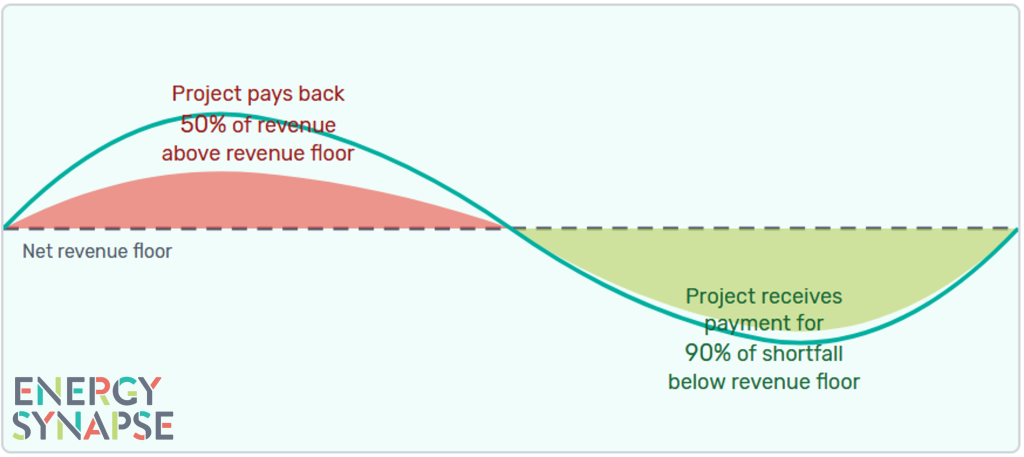
Revenue Floor Mechanism: The FERMA provides a two-way payment structure:
- Projects receive payments when net revenue falls below a pre-agreed floor ($/year). Calculated in Tender 1 as 90% × (Revenue Floor – Net Revenue), subject to cap.
- Projects make upside obligation payments to the scheme in years where net revenue exceeds the floor. Calculated in Tender 1 as 50% × (Net Revenue − Revenue Floor), subject to cap.
Tender 1 specifics
Capacity targets
- Category 1: 400 MW by November 2028
- Category 2: 200 MW by November 2029
- Category 3: 100 MW by November 2031
Timeline
Contract execution expected March-April 2026, making Category 1’s November 2028 Commercial Operations Date (COD) less than 3 years away.
Key eligibility criteria
- Minimum 30 MW capacity.
- Continuous dispatch for at least 8 hours. Batteries must take into account degradation of storage capacity to ensure ≥ 8-hour dispatch capability over the 15-year contract term.
- Must not be coal or nuclear. Battery storage and gas are expected to be the main bidders.
- Bid Entity must be a Special Purpose Vehicle (SPV) that only carries on the Project and conducts no other business.
- Facility must not have been awarded a Capacity Investment Scheme Agreement (CISA) and does not intend to bid for a CISA.
Should your project bid in the Firm Energy Reliability Mechanism?
Projects are evaluated on development status, financial capacity, technology maturity, consumer cost impact, and proposed commercial terms. ASL will prioritise deliverability, financial credibility, and minimising scheme cost exposure.
Strong candidates
- Advanced development status (land secured, planning approvals obtained, grid connection well-progressed (or executed)
- Targeting Category 1 with EPC capability and secured supply chain
- Financial strength to support development capital through contract execution
- Proven technology at 8+ hour duration
Weak candidates
- Early-stage development (conceptual designs, no permits)
- Technology risk (e.g. first-of-kind at 8-hour duration)
- Unrealistic schedules without credible path to November 2028 COD
- Fundamental disagreement with FERMA structure requiring extensive commercial departures
Strategic considerations
- Revenue floor tradeoff: Developers must carefully model where to set the revenue floor. For example, an aggressively competitive floor may win a tender but could provide limited bankability benefits while also giving away substantial merchant revenue potential. Finding the right balance is key. Developers with multiple projects in South Australia could also consider bidding some projects into FERM, and not others, to balance revenue certainty against merchant flexibility.
- Incomplete policy framework: Reliability and liquidity obligations remain undefined (expected mid-2026), and fuel price determination for gas is unpublished. Developers are bidding into a partially defined framework where post-contract obligations may be imposed.
- Political sustainability: FERM is funded by South Australian electricity consumers. If scheme costs drive perceived price increases, political pressure for reform could emerge. Australia’s history of modified or abandoned energy market reforms creates long-term risk despite 15-year contract protection.
Energy Synapse specialises in revenue modelling and strategic advisory for utility-scale renewable and storage developers. Contact us for a confidential discussion about your project.