Queensland BESS revenue falls 70% as supply grows without coal exits
September 16, 2026
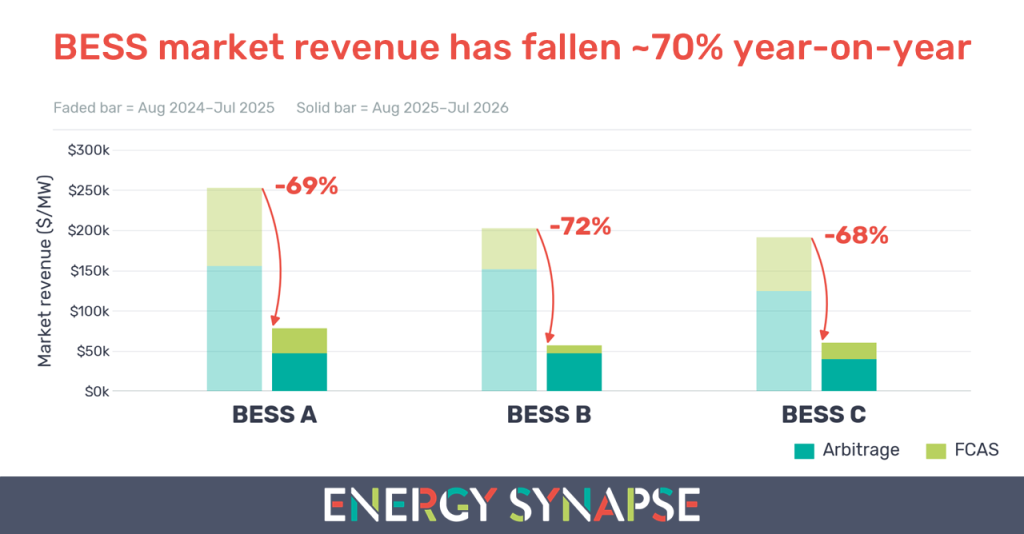
Data from the Energy Synapse Platform shows market revenue for Queensland’s utility-scale batteries fell by 70% in the 12 months to 31 July 2026, compared with the prior 12 months.
The chart below shows the revenue decline from energy arbitrage and frequency control ancillary service (FCAS) for a sample of three Queensland batteries that were operating over the entire 24 month period, normalised on a $/MW basis. The three batteries have similar durations, ranging from 1.5 to 2 hours. All three recorded a decline within a narrow 68% to 72% band from $191k-253k/MW to $57k-79k/MW.
This is one snapshot of a much larger dataset. The Energy Synapse Platform tracks actual BESS revenue, duration and contract structures for the entire NEM fleet so you can benchmark against what the market is actually delivering.
Three factors help explain the revenue crunch:
- Rapid deployment of utility scale BESS across Queensland, and the NEM more broadly, has increased competition for the same pool of arbitrage and FCAS revenue.
- Federal Cheaper Home Batteries Program has added significant distributed battery capacity that also competes for daytime and evening price spreads.
- No coal exited the market.
In short, supply grew but the market did not tighten in response. This highlights a “chicken and egg” problem the market is starting to face. State governments want to see oversupply in the market before they will allow coal to close; whereas developers need to see the price signal in the market in order to invest in new capacity.
BESS deployment in Queensland has grown rapidly since 2023
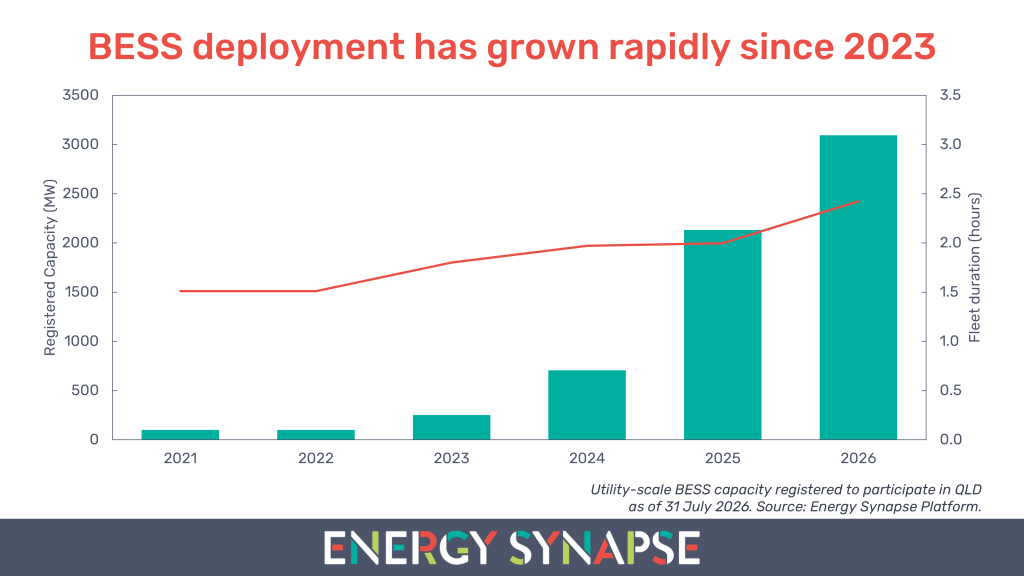
Part of the revenue story above is really a growth story. As of 31 July 2026, more than 3 GW of utility scale BESS is registered to participate in the NEM in Queensland.
A decade ago, grid scale batteries were a nascent technology with an uncertain future. Today, they are a mature and well understood asset class. Developers and investors treat battery storage as a core part of the energy transition, not an experimental addition to it.
At the same time, capital costs have continued to decline, including by a further 15% over the past financial year according to the CSIRO’s latest GenCost report.
The shape of the fleet is also changing. Average storage duration across Queensland’s BESS fleet has risen steadily, from 1.5 hours in 2021 to 2.4 hours in 2026. Developers are increasingly building batteries designed to shift energy over longer periods, rather than simply providing short bursts of frequency response. For BESS projects under development, the Energy Synapse Platform shows 4-hour duration is currently the most popular choice.
Coal extensions are a key risk for Queensland BESS investors
Under the Queensland Energy Roadmap, coal-fired power stations in Queensland are expected to operate into the late 2040s. This is now also reflected in AEMO’s 2026 Integrated System Plan. On the surface, that timeline reduces the near term urgency for storage, particularly long duration storage.
However, this is a trap. Whether Queensland’s coal fleet can actually operate through to the late 2040s is highly uncertain, from both a technical and economic perspective. At the same time, electricity usage is expected to grow significantly due to electrification of the economy and growing industries like data centres. Queensland has a very healthy pipeline of battery projects under development, which is encouraging. But the policy signal about coal’s longevity carries a real risk and could lead the state to under build the renewable generation and storage capacity it will actually need, particularly if coal retires earlier than planned or becomes less reliable.
Investors and developers need to plan for a range of coal retirement scenarios, not only the one embedded in current policy.
Where this leaves the market
Queensland’s battery storage market is maturing quickly, but the next phase will be more complex than the last. Queensland has a further 2 GW of BESS capacity which has reached financial close. Once built, this will add further pressure to arbitrage spreads.
Data from the Energy Synapse Platform shows that 88% of Queensland’s committed BESS capacity is part of a hybrid project. This highlights the value of firmed electricity supply in the face of growing load. Solar/BESS hybrids have historically been more common in the development pipeline. However, we are seeing strong growth in wind/BESS hybrids as developers seek to extract maximum value from their sites.
Merchant revenues over the next 20 years are likely to be volatile. This makes revenue risk management essential to bankability, whether it be through physical or virtual offtakes, government underwriting, or vertical integration.
These fast changing dynamics require more rigorous, data led decision making than the market has needed to date. This is exactly the gap Energy Synapse is designed to fill. Our analytics platform brings together advanced tracking of the BESS development pipeline, contract structures, and market revenue data across the NEM, so developers, investors, and financiers can test their assumptions against the market. Furthermore, our bespoke market and revenue modelling services give your investment committee a defensible view of the revenue opportunity under multiple future scenarios and project configuration options.
This article is based on a presentation at the Queensland Energy & Economic Summit 2026 by Energy Synapse Managing Director Marija Petkovic.