Building the business case for long duration storage in the NEM
November 9, 2026
Australia’s National Electricity Market (NEM) needs long-duration energy storage (LDS) as coal retires. Yet for private developers, building a bankable business case for 8+ hour storage remains challenging.
This article summarises the presentation at All-Energy 2026 by Energy Synapse Managing Director, Marija Petkovic, using data from the Energy Synapse Platform to show where the pipeline stands, why these projects are difficult to finance, and the contract structures that can make them work.
KEY TAKEAWAYS
- Nights are the problem. Even on the NEM’s record renewable days in September 2026, fossil fuels still supplied an average of 12 GW overnight. In the June 2026 wind lull, it was 19 GW.
- 8+ hour storage is the second most popular duration in the NEM development pipeline (21% of power capacity), behind 4 hours (51%).
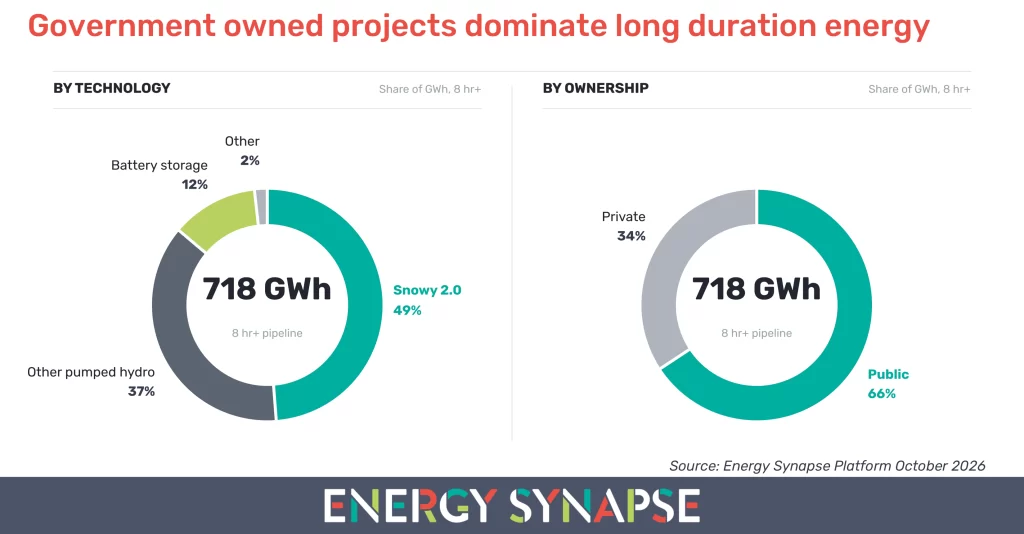
- Governments own two thirds of long-duration energy. Of 718 GWh under development, 66% is government-owned, and Snowy 2.0 alone is 49%.
- Revenue risk is the core barrier. Long-duration value depends on rarer events and the pace of coal closures, both hard to bank.
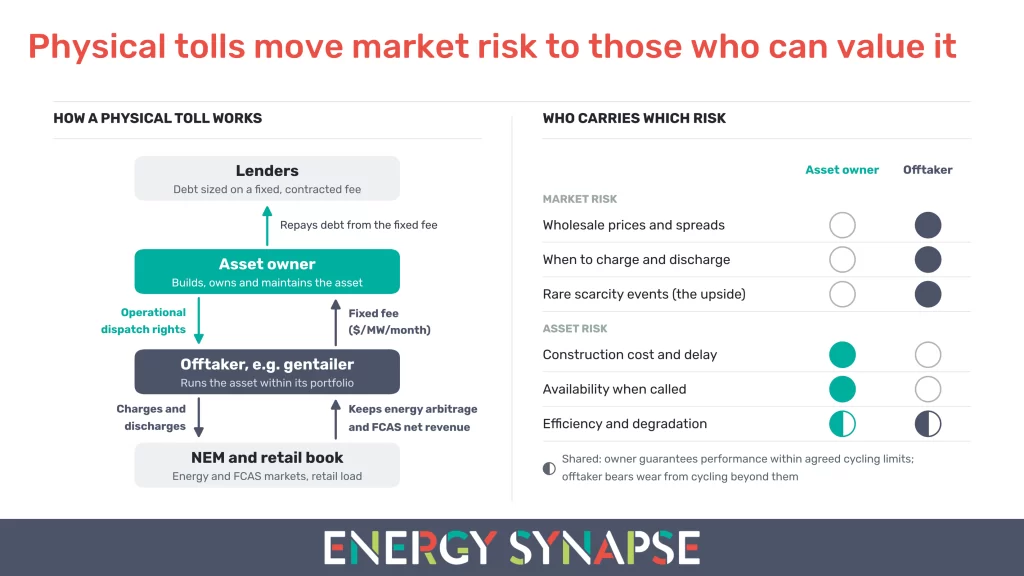
- Physical tolls help. They move market risk to an offtaker, usually a gentailer, who can value it, leaving lenders with a fixed fee to finance.
The NEM needs storage that can last through the night
Almost 15 GW of coal capacity, around 70% of today’s fleet, is expected to retire from the NEM by FY2036 under AEMO’s 2026 Integrated System Plan. Over the same period, data centre consumption is forecast to grow about sevenfold, from around 5 TWh to around 34 TWh, and data centres run 24/7.
Solar makes daytime supply abundant. The harder job is the night. Even on the best two consecutive days for renewables in our data, 19 to 20 September 2026, when renewables and storage met 59% of load, fossil fuels still supplied an average of 12 GW between 5PM and 7AM. During the June 2026 wind lull, the overnight gap rose to 19 GW.
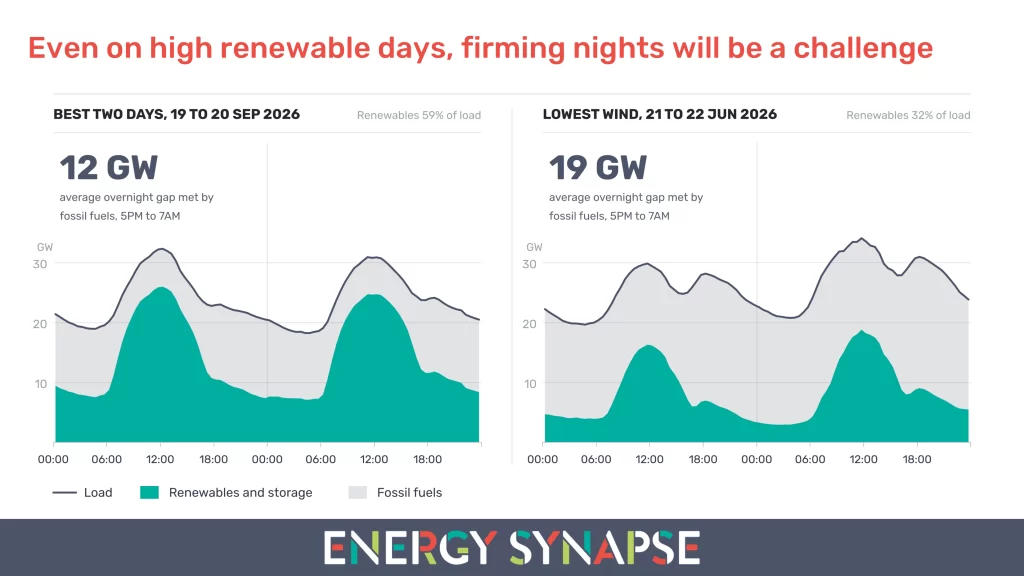
A 4-hour battery covers the evening peak, but not a 14-hour renewable trough, let alone a multi-day wind lull. Filling the gap as coal exits will take more wind and solar, plus storage that can shift that energy into the night.
The development pipeline shows growing interest in long duration storage
Data from the Energy Synapse Platform shows that 4 hours is the most popular storage duration in the NEM development pipeline, accounting for around half of power capacity among projects with a stated duration. Long-duration storage (8+ hours) is the second most popular choice at 21%.
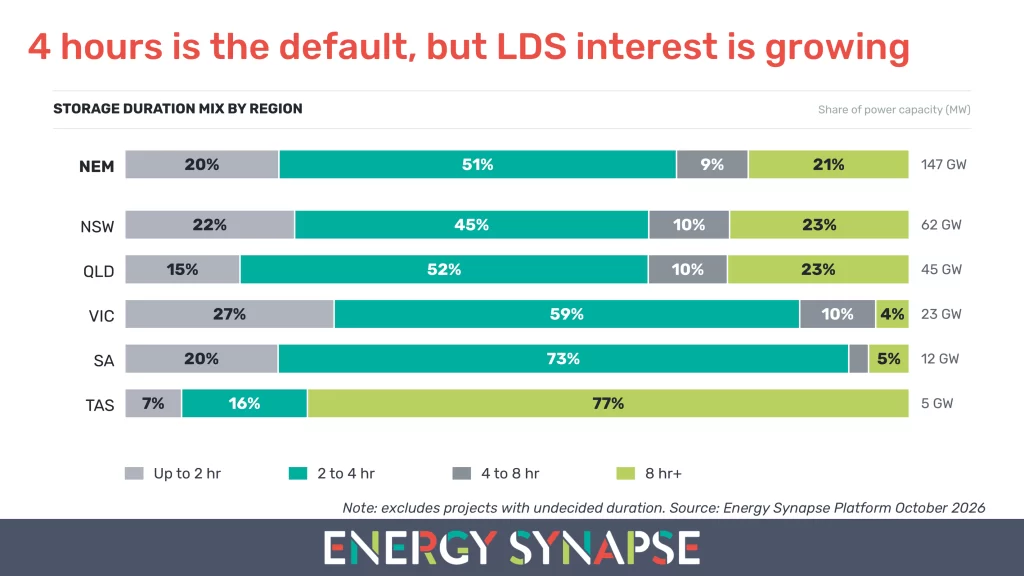
Batteries make up over half (53%) of long-duration projects by count. But because pumped hydro projects are much larger and deeper, batteries account for only 32% of long-duration power capacity (GW) and just 12% of energy capacity (GWh).
Of the 718 GWh of long-duration energy capacity under development, 49% comes from a single project, Snowy 2.0, and a further 37% from other pumped hydro projects. Given this technology mix, it is unsurprising that 66% of the energy capacity is government-owned rather than private.
So, if you are a private developer, how do you build a bankable business case for long-duration storage?
Why long duration storage is hard to bank, and what we recommend
We see four main barriers. Many developers are only starting to work through them, so for each one we set out what we recommend based on our market modelling and project work. The table summarises our view, and the sections below explain it in more detail.
| Barrier | Why it matters | What we recommend |
|---|---|---|
| Revenue uncertainty | Value relies on rare events and the pace of coal closures | Seek government underwriting, consider physical tolls, take care with cap contracts |
| Shallow offtake market | Few buyers for 8+ hour or long-dated products | Target gentailers replacing coal and data centres needing 24/7 firming |
| Construction and cost risk | Mainly pumped hydro: civil works and geology | Favour batteries for private developers; leave pumped hydro to government-led or underwritten projects |
| Technology risk | Limited operating history for alternatives to lithium and pumped hydro | Separate proven components from new integration, and back the new parts with evidence |
1. Revenue uncertainty
THE CHALLENGE
Compare a 100 MW battery with 4 hours of storage against one with 10 hours. The value of those extra 6 hours depends on rarer market events, such as multi-day wind lulls and extended evening peaks, which are more difficult to finance.
Long-duration revenue is also very sensitive to the pace of coal closures, which is highly political in Australia. Coal policy can change sharply with a change of government, as we have seen in Queensland.
Furthermore, the revenue environment is very soft right now. The Energy Synapse Platform shows actual battery revenue fell by over 60% in the 12 months to August 2026, as new batteries have been rapidly deployed without any coal exits.
WHAT WE RECOMMEND
- Seek government underwriting. Schemes such as the Long Duration Storage LTESA in NSW and the Firm Energy Reliability Mechanism (FERM) in South Australia provide long-term revenue support for 8+ hour projects.
- Consider a physical toll. It moves market revenue risk to the offtaker (see below).
- Be careful with cap contracts. Selling $300 caps on the ASX, or the proposed $600 firming cap under the Electricity Services Entry Mechanism (ESEM), can expose storage to long high-price events.
2. Shallow offtake market
THE CHALLENGE
Historically, few retailers have wanted 8+ hour products or been willing to sign long-dated contracts.
WHAT WE RECOMMEND
- Target gentailers that need to replace coal. As coal closes, their retail books are exposed in the evenings, overnight and during winter wind lulls. In our view, gentailers are best placed to value long-duration storage.
- Look to data centres as a growing opportunity. Proposed national rules would require large data centres to underwrite new renewables and contract firming, with legislation expected in 2027. With 24/7 load, data centres will value storage that can cover the night.
3. Construction and cost risk
THE CHALLENGE
This is mainly a pumped hydro risk, driven by complex civil works and uncertain geology. The cost estimate for Snowy 2.0 has risen from $2 billion when it was announced in 2017 to up to $25 billion in October 2026.
WHAT WE RECOMMEND
- For private developers, we see batteries as the safer choice, with shorter build times and more predictable costs.
- Pumped hydro is generally better suited to government ownership or significant government underwriting.
4. Technology risk
THE CHALLENGE
Alternatives to lithium-ion and pumped hydro are often seen as higher risk because of their limited operating history. That makes warranties, performance guarantees and insurance harder to obtain.
WHAT WE RECOMMEND
Many alternative technologies are built from standard components that have been used in other applications for decades. When speaking with investors and offtakers, we recommend that developers clearly separate the parts of their system that are proven at scale from the components or integration that is genuinely new, and back the new parts with test data, demonstration results or performance guarantees.
Physical tolls move market risk to those who can value it
A physical toll is an offtake agreement that works much like a long-term lease and works particularly well for long duration storage. The asset owner builds, owns and maintains the asset and receives a fixed fee ($/MW/month) from the offtaker. The offtaker holds the operational dispatch rights and keeps the net revenue from energy arbitrage and frequency control ancillary services (FCAS).
Lenders can then size debt on the fixed, contracted fee rather than on volatile market revenue, which manages one of the biggest risks for a long duration storage project. The offtaker is usually a gentailer, because operating the asset requires an experienced market participant. A gentailer is also best placed to understand and value the market revenue risk, including the rare scarcity events that lenders shy away from.
Kidston pumped hydro in Queensland is an example. EnergyAustralia holds operational dispatch rights and pays Genex a fixed, escalating annual fee for up to 30 years.
How Energy Synapse can help
Energy Synapse helps developers, investors and offtakers build bankable storage projects in the NEM.
- Know the market with the Energy Synapse Platform. Track every storage project in the NEM pipeline, including duration, ownership, status and underwriting, and benchmark operating assets against their peers.
- Build the business case with market and revenue modelling. Revenue modelling for standalone and hybrid projects, including 8+ hour storage and volatility modelling. Test contract structures before you sign: tolls, swaps, LTESA, FERM and ESEM.
- Build capability with NEM training. Courses include Electricity Industry Fundamentals and Commercial Opportunities for Battery Storage in the NEM.
Developing a long-duration storage project, or weighing up an offtake or underwriting contract? Talk to our team or request a Platform demo.