NEM BESS revenue falls over 60% in 12-months to August 2026
September 24, 2026
NEM BESS revenue from wholesale energy arbitrage and frequency control ancillary services (FCAS) has fallen over 60% in the 12 months to 31 August 2026, compared to the prior 12-month period.
Data from the Energy Synapse Platform shows that the median revenue fell from:
- $195k to $63.4k per MW in Queensland (down 67%)
- $172k to $57.7k per MW in South Australia (down 66%)
- $135k to $52.1k per MW in New South Wales (down 61%)
- $83.4k to $26.5 per MW in Victoria (down 68%)
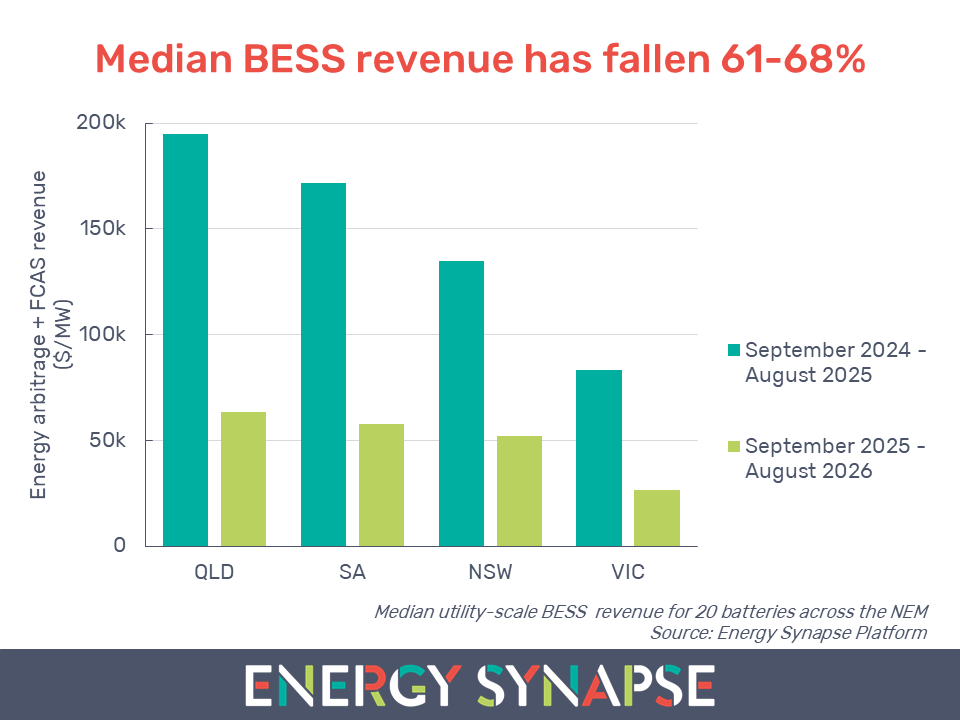
In this article, we report the median (50th percentile) revenue achieved by batteries to give an indication of typical performance in each NEM region. Readers should be aware that even within a region, there can be significant variation in revenue between individual assets. This is due to factors such as trading and offtake strategy, marginal loss factors, and constraints.
Subscribers to the Energy Synapse Platform can explore granular asset level performance for every BESS registered in the NEM, including merchant revenue, offtakes, hardware suppliers and more. The Energy Synapse Platform also maps the full pipeline of power projects under development.
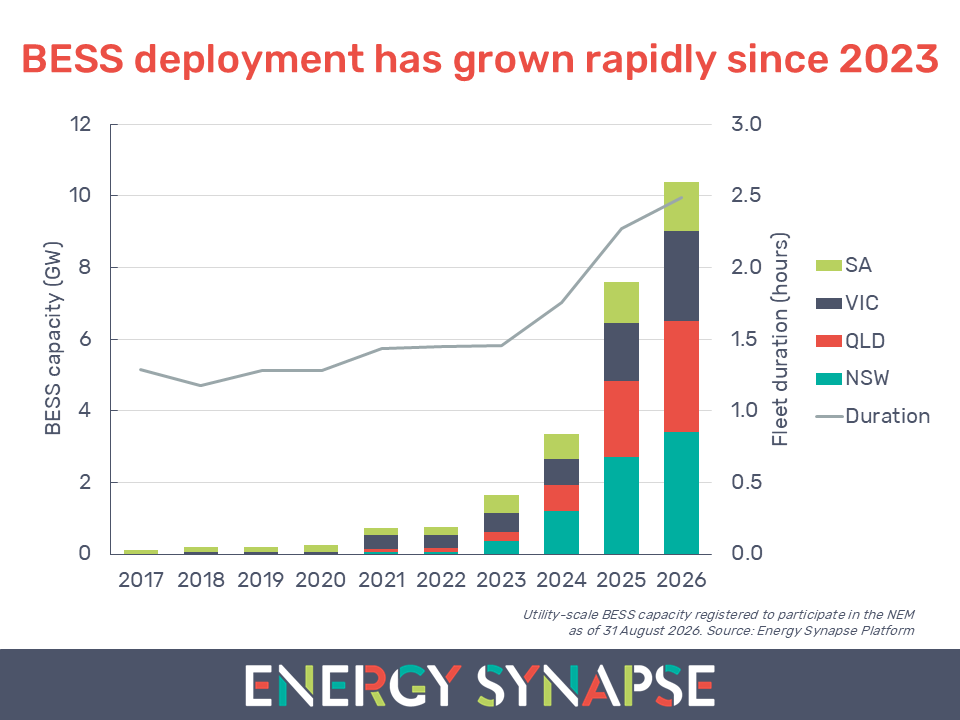
Rapid deployment of BESS has compressed the revenue opportunity
As of 31 August 2026, there over 10 GW of utility-scale batteries registered to participate in the NEM, which is more than six times higher than in 2023. The storage duration of the NEM BESS fleet has also been steadily increasing from 1.3 hours in 2017 to 1.5 hours in 2023, and now 2.5 hours in 2026.
Data from the Clean Energy Regulator shows there are currently over 450,000 home batteries installed across the NEM. The grid now has a very large supply of firming resources at both the utility-scale and distributed levels. This has put downward pressure on BESS revenue.
Coal exits and load growth will drive the case for further renewables and storage
Almost 15 GW (70% of coal fleet) is expected to retire from the NEM over the next decade according to AEMO’s 2026 Integrated System Plan. Over the same time horizon, electricity consumption is expected to grow by almost 40% due to electrification of the economy and growing industries like data centres. Despite the current soft revenue situation, these forces drive a fundamental need for more investment in renewables and storage.
Read our similar analysis on wind and solar revenue across the NEM in the 12 months to 31 August 2026.
Methodology for NEM BESS revenue analysis
The Energy Synapse Platform estimates the revenue earned by every utility-scale battery across the NEM from wholesale energy arbitrage (inclusive of site specific marginal loss factors) and FCAS. The Energy Synapse Platform tracks the full operational history of every battery in the NEM from the moment its’ SCADA goes live.
For the analysis in this article, we have only considered batteries that were operating over the full 24-month period from 1 September 2024 to 31 August 2026, that are greater than or equal to 10 MW in size and have at least one-hour of storage duration. This gave us a sample size of 20 batteries across Australia’s National Electricity Market. The batteries in the sample have storage durations from 1-hour to 2.1 hours, with a median of 2-hours.